Pantry
Blackberry Jam Recipe (With Video)
By Samira Kazan
updated July 22, 2024
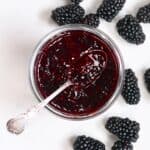
Learn how to make blackberry jam at home using just four ingredients. My foolproof method is beginner jam-makers friendly , allowing you to store the blackberry jam short term or preserve it for long-term storage.

Important note: This recipe was updated and improved on July 12, 2024, to include more information on proper canning, storage, and more tips. It was originally published on July 22, 2020.
Every time I eat blackberry jam, it reminds me of blackberry picking on warm summer evenings. That’s why I’ve developed this easy homemade blackberry jam recipe – it allows you to preserve the summer’s bounty and enjoy luscious, tasty jam year long.
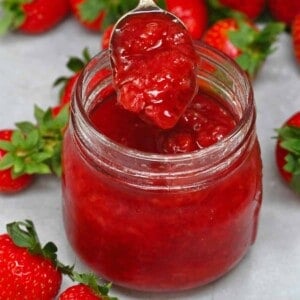
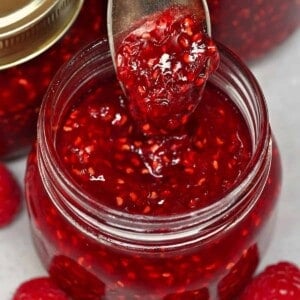
For this recipe, you need only four ingredients: blackberries, lemon juice, sugar, and pectin. Working with a small batch like my recipe allows you to make the jam in under 20 minutes. Prepare this along with homemade strawberry jam and easy raspberry jam (no-pectin) , and you are ready for your summer garden party or Sunday brunch! You can also serve it alongside homemade fig jam to complement a cheese board!

Want to save this recipe?
- Watch blackberry jam video tutorial
- Ingredients
- How to make blackberry jam
- Using liquid pectin
- Storage
- Recipe notes and variations
- Ideas for serving blackberry jam
- More homemade jam recipes
- Blackberry Jam Recipe (With Video) Recipe
Watch blackberry jam video tutorial
Ingredients

- Blackberries: You can use store-bought or wild berries. Fresh or slightly underripe are best.
- Sugar: White granulated sugar is most common but if wanted, you can use unrefined brown sugar, coconut sugar, or other granulated variety.
- Pectin : Use either powdered pectin or liquid pectin, depending on what you have. The steps will be slightly different, but both are described below. Also, keep in mind that using liquid pectin results in a softer jam.
- Lemon juice: To balance the flavor (optional).
See the recipe card for full information on ingredients and quantities.
How to make blackberry jam
Prepare the jars
First, sterilize your equipment. Wash the jars, lids, and bands in hot, soapy water and rinse them well. Place them on a clean surface.
If you’re planning to can the jam, prepare the canner by adding the trivet/rack to the bottom and filling it with enough water to submerge the jars by 2 inches. Bring to a boil over medium heat and boil the sterilized jars for 10 minutes. Then, keep them in the water so they stay warm until ready to fill.
Using powdered pectin
Prepare and mash the blackberries: Start by washing and drying the berries. Then, crush them lightly in a bowl (or the pan) using a potato masher or similar tool. Add the powdered pectin and mix it well into the crushed berries. I also like to squeeze in the lemon juice now so it can be incorporated into the mashed blackberries.

Cook the jam mixture: Transfer the mixture to a medium heavy-based pan and bring to a boil over high heat. Stir frequently to allow the pectin to dissolve completely.
Then add all the sugar and bring the mixture to a full rolling boil. Stir constantly to allow the sugar to dissolve. Once you have a full rolling boil, let the jam boil for 1 minute.
Finally, remove the pan from the heat and skim off any excess foam from the surface of the jam. Continue with the jarring steps below.

Using liquid pectin
Prepare the blackberries: Wash and dry the berries. Then, mash them lightly in a bowl (or the pan).
Cook the jam: Transfer the crushed blackberries to a medium heavy-based pan and add the sugar and lemon juice. Bring to a rolling boil over high heat and stir constantly to help dissolve the sugar.
Add the liquid pectin and stir to incorporate. Keep the rolling boil for 1 minute and stir constantly. Finally, remove the pan from the heat and skim off any excess foam from the surface of the jam. Continue with jarring the jam.
Jar the jam
Place the jars on a heatproof surface and fill them with the jam to about ¼ inches (0.5 cm) from the top. This process is easier with a canning funnel. Wipe away any spillage on the outside of the jar with a damp cloth, and then seal the jars.
As the jam cools, it will set into a thicker consistency. The jam is now ready to enjoy or store short-term in the fridge or freezer.

Can the jam (optional)
Check my Canning Guide for Beginners , where I explain in detail how to proceed with each step. In short, once you’ve filled the jars to ¬º inch (0.5 cm) from the top, make sure to remove air bubbles. Adjust the headspace if needed, wipe the rime, and then screw the lid to fingertip-tight. Then, using tongs (you can get specific jar ones), lower your jars back into the pan of boiling water, making sure they are around 2 inches deep in the water.
Bring to a boil and process the jars with the canner lid on for around 10 minutes (this can change depending on your altitude). Then, remove the lid and let the jars rest for 5 minutes in the canner. Finally, remove the jars from the water and leave them to cool on a wooden or another heatproof surface. You’ll know that the lids are sealed properly when they are concave and won’t wiggle when pressed. If you have one that hasn’t been sealed properly, then place it in the fridge to use first.
Voila, your homemade blackberry jam is ready to store in your pantry or cupboard!
Storage
- Short-term storage: Once you fill the jars with the jam, you can store them in the fridge for up to three weeks or in the freezer for up to six months.
- Long-term storage: To do this, you need to properly can the jars using the hot water bath canning method . The jars can then be kept in a cool, dry, dark location like your cupboard or pantry for around 1.5 years.

Recipe notes and variations
- Use fresh berries: Fresh or slightly underripe blackberries are best for jam due to their higher pectin content and balanced sweetness.
- Wild blackberries: When using wild or farm-to-table style berries, it’s best to clean them thoroughly. Soak in salted water to clean and remove bugs. Then, dry them thoroughly so they don’t spoil. Note that wild blackberries contain more pectin than many store-bought varieties, which means you can reduce (or even eliminate) the need for additional pectin entirely.
- Lemon juice: I use fresh lemon juice in my recipe, but you can also use bottled lemon juice. Its consistent pH level makes it a reliable and safe option for jams.
- Fewer seeds in the jam: You need to sieve the mixture if you want fewer seeds in the jam. First, mash the blackberries and add them to the saucepan with the lemon juice. Simmer for a few minutes to break down the fruit, then press through a sieve or jelly bag into a bowl. Place the blackberry juice back in the pan along with the sugar and pectin to continue cooking. Add 2-3 spoonfuls of the collected seeds back into the jam or skip them entirely for more of a blackberry jelly (which uses blackberry juice only).
Ideas for serving blackberry jam
The sky is the limit when it comes to using this freshly made blackberry jam. Here are some of my favorites:
- Spread it on toast: Of course, it tastes amazing, spread over warm toast, homemade bagels , or even homemade croissants . It’s also a great topping for pancakes and waffles.
- Fill desserts: You can fill pastries, cakes, tarts, and cookies (blackberry jam makes a great combo with these pistachio thumbprint cookies ).
- Top yogurt and oatmeal: It’s a great way to add a fruity and sweet boost to your morning breakfast bowls.
- Swirl into ice creams: Mix some jam into this vanilla ice cream or add a few spoonfuls to these vegan magnum ice creams .
- Glaze for meats: Mix the jam with vinegar, soy sauce, or mustard; this creates a sweet and savory glaze that enhances the meat’s flavor (try it for chicken, duck, or pork).
More homemade jam recipes
Equipment
- 7 Canning jars (8 oz) (250 ml)
- Heavy-based stainless steel saucepan
- Silicone spatula
- Potato masher or another similar tool
IngredientsUS CustomaryMetric1x2x3x
- ▢ 3.2 pounds blackberries 10 cups whole fresh blackberries (5 cups crushed)
- ▢ 3.3 lb white sugar 7 cups
- ▢ 1/4 cup lemon juice freshly squeezed or bottled, optional
- ▢ 6 Tbsp powdered pectin OR liquid pectin
Instructions
Prepare the jars
- Sterilize your equipment. Wash the jars, lids, and bands in hot, soapy water and rinse them well. If you plan to can the jam, prepare the canner as well (see the steps below).
Using powdered pectin
- Wash and dry the blackberries. Crush them lightly in a bowl (or pan). Add the powdered pectin and mix it well into the crushed berries. Squeeze in the lemon juice and stir to combine.
- Add the blackberry mixture to a medium heavy-based pan and bring to a boil over high heat. Stir frequently to allow the pectin to dissolve completely.
- Add all the sugar and bring the mixture to a full rolling boil, stirring constantly. Once it reaches a full rolling boil, let the jam boil for 1 minute.
- Remove the saucepan from the heat and skim off any excess foam from the surface of the jam. Continue with the jarring steps below.
Using liquid pectin
- Wash and dry the berries and mash them lightly in a bowl (or the pan).
- Transfer them to a medium heavy-based pan and add the sugar and lemon juice. Bring to a rolling boil over high heat and stir constantly.
- Add the liquid pectin and stir to incorporate. Keep the rolling boil for 1 minute and stir constantly.
- Remove the pan from the heat. Skim off any excess foam. Continue with the next step.
Jar the jam
- Place the jars on a heatproof surface and fill them with the jam to about ¼ inches (0.5 cm) from the top.
- Wipe away any spillage on the rim and outside of the jar with a damp cloth, and then seal the jars.  This blackberry jam is now ready to enjoy or store short-term in the fridge (3 weeks) or freezer (6 months).
Water-bath canning (optional)
- Prepare your canner by adding the trivet/rack to the bottom and filling it with enough water to submerge the jars by 2 inches. Bring to a boil over medium heat and boil the jars for 10 minutes. Keep them in the water so they stay warm until ready to fill.
- Fill the jars with the jam to about ¼ inch (0.5 cm) from the top, and make sure to remove air bubbles. Adjust the headspace if needed. Wipe the rim. Then screw the lid to fingertip-tight.
- Using tongs, lower your jars back into the pan of boiling water, making sure they are around 2 inches deep. Bring to a boil and process the jars with the lid on for around 10 minutes (this can change depending on your altitude). Then, remove the lid and let the jars rest for 5 minutes in the canner.
- Remove the jars from the water and leave them to cool on a heatproof surface. The lids are sealed properly when they are concave and won’t wiggle when pressed. If you have one that hasn’t been sealed properly, place it in the fridge to use first. The rest can be stored in a cool, dry place like a pantry or a cupboard for up to 1.5 years.
Video
Notes
Nutrition
Nutrition information is automatically calculated, so should only be used as an approximation.
Recipes › Desserts
Almond Pistachio Thumbprint Cookies Recipe
By Samira Kazan
updated September 21, 2020

Delicious gluten-free, vegan bite-size almond & pistachio thumbprint cookies. Not only are they easy to make- they can either be baked or kept as a no-bake cookie recipe!
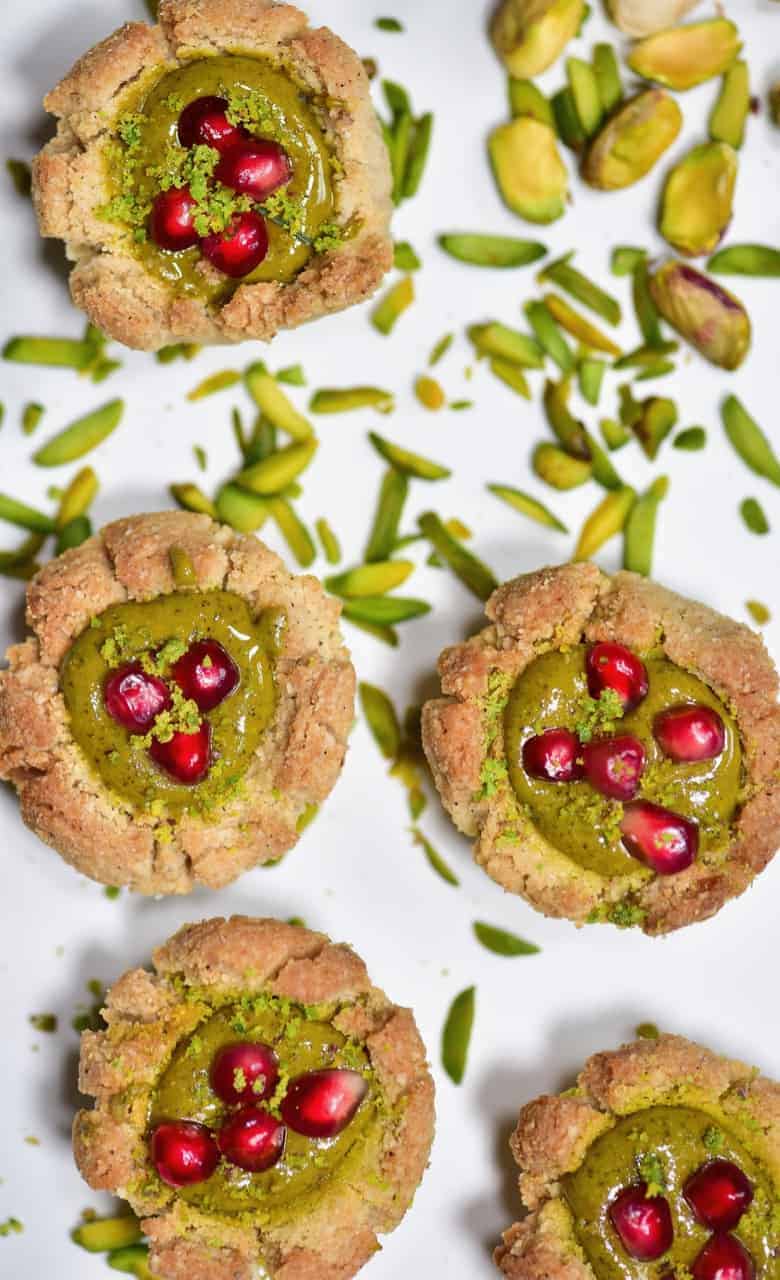
These almond pistachio thumbprint cookies are a delicious vegan and gluten-free cookies recipe using almond flour and pistachio butter. Unlike your generic shortbread thumbprint cookies, these vegan bite-size snacks have a delightful crumbly almond base and can be cooked or kept as a no-bake cookie recipe.
Depending on whether you want these as raw snacks or baked cookies, they are delicious. However, it’s worth noting that there will be some textural difference.
For the raw version, these pistachio thumbprint cookies are a little more gooey and moist. In comparison, when baked, these cookies are more crumbly.
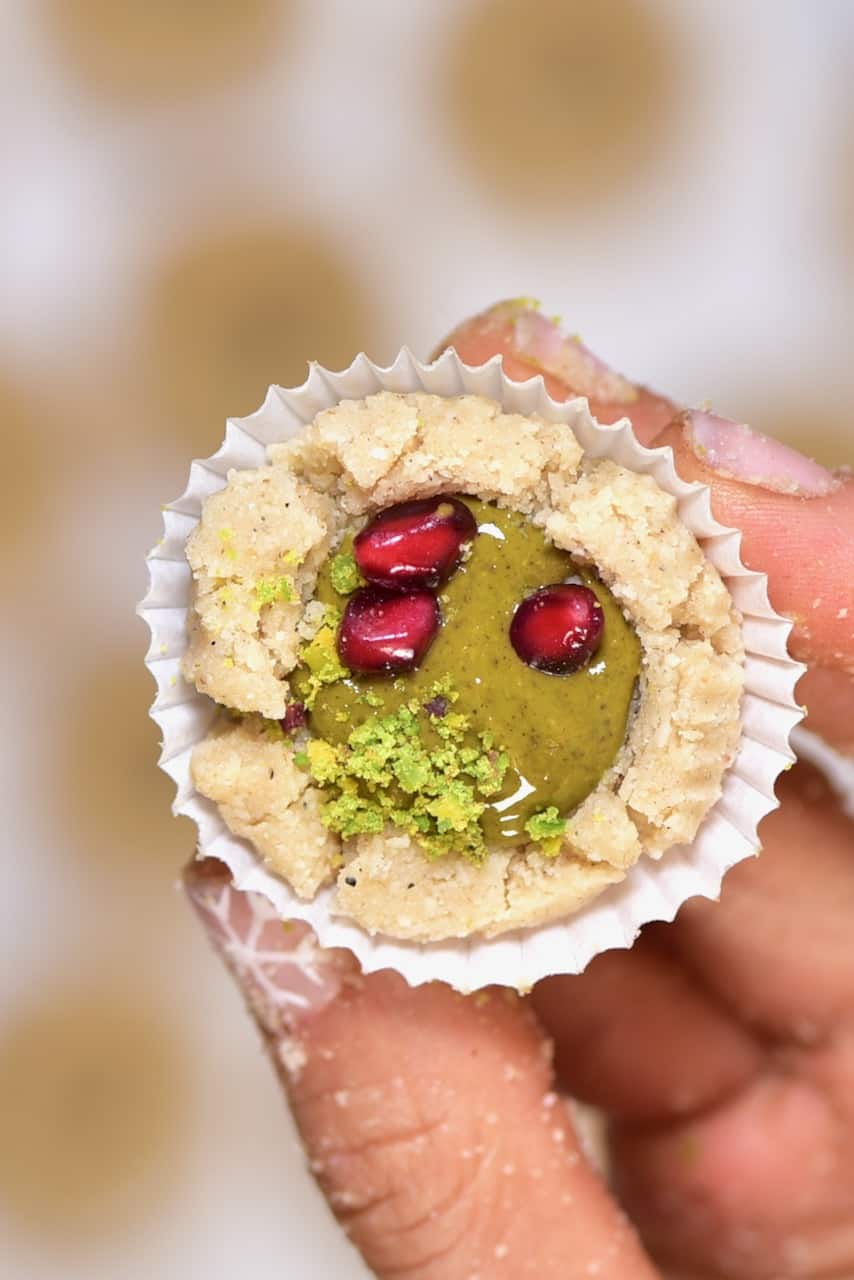
I always love to switch up classic recipes and decided that rather than using the usual choice of jam filling for this thumbprint cookie recipe, I used some homemade pistachio butter .
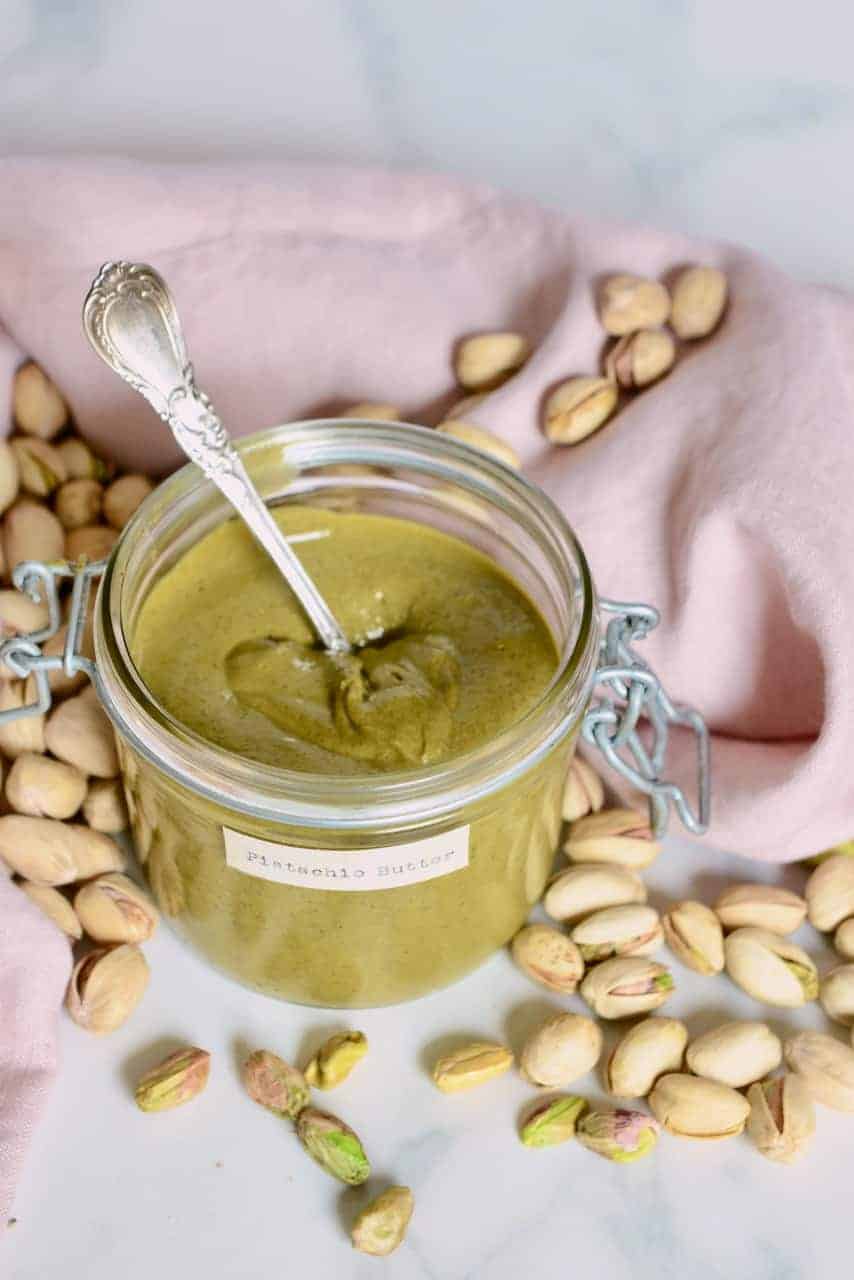
Pistachio butter is one of the most delicious, decadent version of all nut butters and yet can be made at home with just pistachios, salt and a blender or food processor. Plus the pistachio flavour compliments the flavour of the gluten-free almond cookies.
These cookies are then an excellent healthier cookie snack option. They can also be displayed in mini cupcake cakes, in a gift box, for a delicious homemade edible gift at Christmas (or any time of the year!).
If you’ve been following me on Instagram, you’ll know that I’ve been cooking up a storm this festive period, with a new recipe posted every day. Honestly, I couldn’t wait for the day to share these pistachio thumbprint cookies though because they are one of my favourite treats so far.
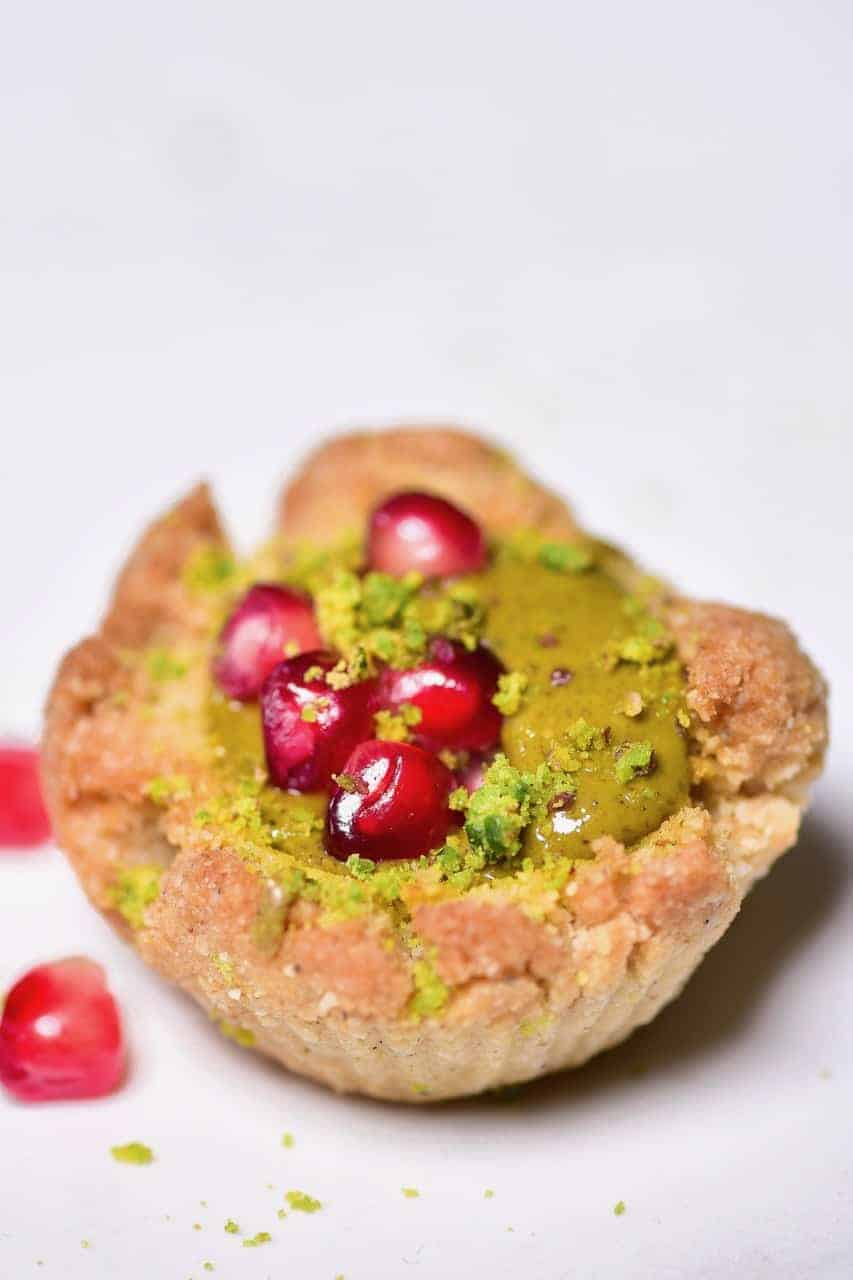
I’ve very recently compiled a post for the ultimate guide to homemade nut & seed butters, so I have spent a LOT of time this year in the kitchen blending up delicious nut butters and nut butter recipes. As much as I have a soft spot for good old almond butter, pistachio butter has taken my heart.
While it’s not a nut butter you’d want to eat by the spoonful every day (or rather you would – but your hips wouldn’t like it!), pistachio butter has an incredible luxury element that works well in so many different recipes. Check out my pistachio butter post for some inspiration.
Want to save this recipe?
- Variations on these thumbprint cookies
- How To Make The Thumbprint Cookies
- Other great snack recipes you may like
- Pistachio Almond Cookies Recipe
Variations on these thumbprint cookies
Obviously, my filling of choice is my homemade pistachio butter. However, you can experiment with various fillings including a delicious vegan homemade Nutella , the classic choice of jam, or even some vegan chocolate chips (that will melt from the heat and be heavenly!).
For a sweeter pistachio creme style filling, melt some white chocolate in a heatproof bowl then mix in some pistachio butter with a dash of homemade vanilla powder .
You can also make a delicious chocolate version of these pistachio thumbprint cookies by adding some cocoa powder into the base almond cookies recipe. If the biscuit mix feels too crumbly after adding the powder, add another tsp of coconut oil to offset the powder.
Plus, you can experiment with additional toppings for the pistachio thumbprint cookies. For example, a drizzle of melted white chocolate is a lovely dessert-like touch.
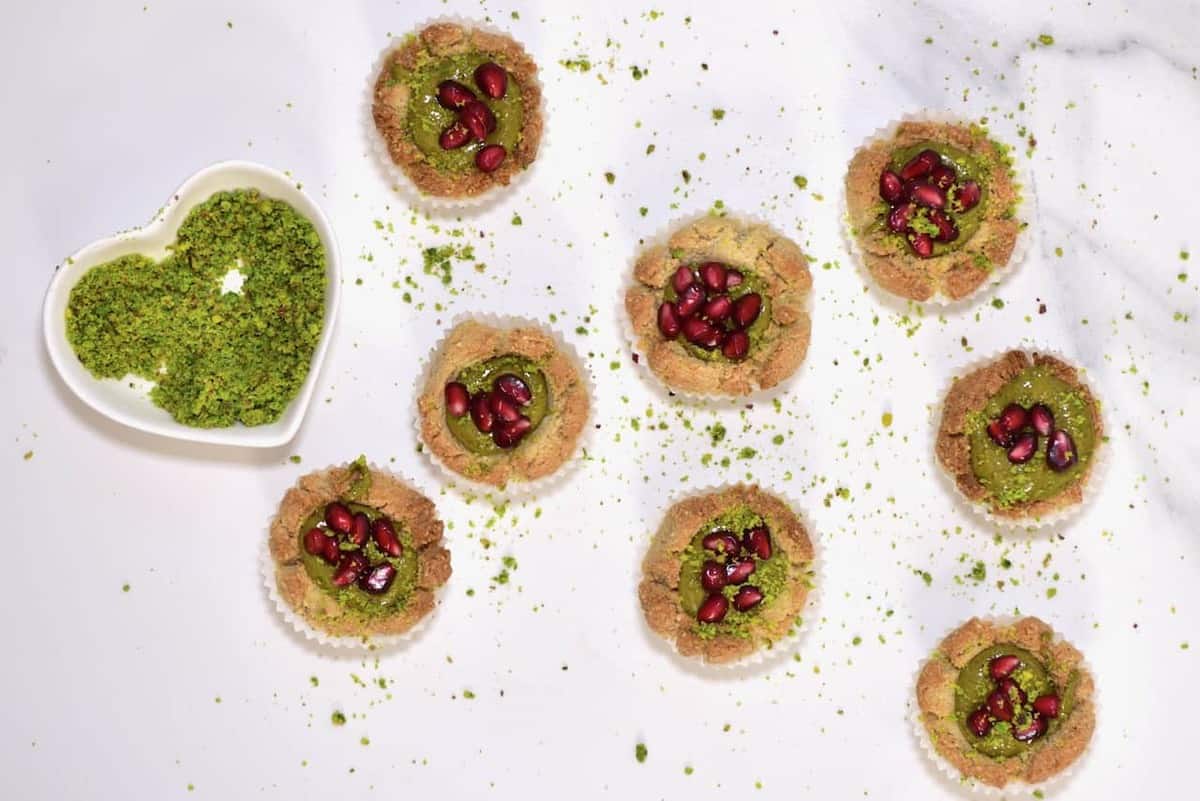
Note* For vegan cookies use dairy-free white chocolate and chocolate chips.
How To Make The Thumbprint Cookies
This pistachio thumbprint cookies recipe is super simple and can be made in just five minutes if you’re keeping them raw. Or around 20 minutes, if baking- which means they’re an excellent option for a last-minute edible gift idea or to whip up on busy days when you don’t have much time to spare.
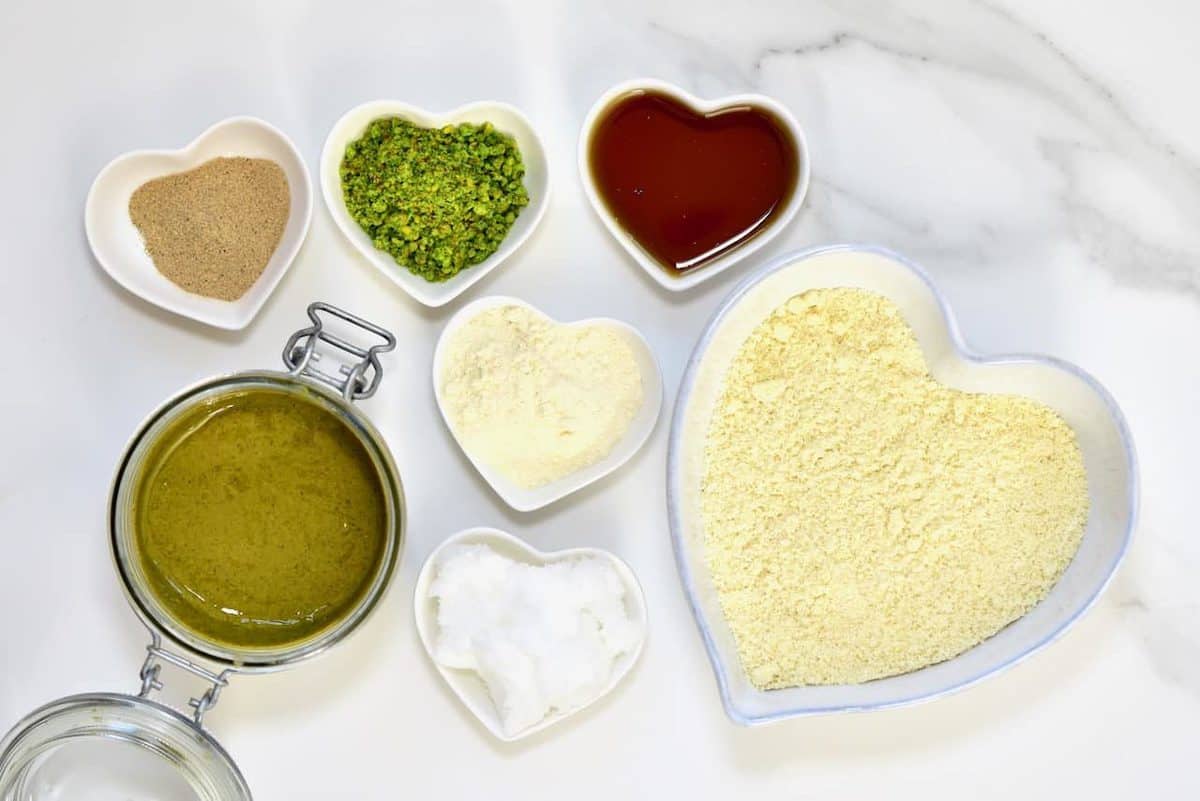
The almond cookies base is made up of almond flour, coconut oil, maple syrup, coconut flour and cardamon.
Don’t fret if you don’t have almond flour to hand though as this can be whizzed up in a couple of minutes. Blitz some raw almonds in a high-speed food processor for a couple of minutes and you’ll get homemade almond flour, which is a great gluten-free flour to have to hand at all times.
This recipe is also a great way to use leftover almond pulp after making homemade almond milk . Simply allow the pulp to dry out, and it’s ready to use as almond flour.
Note* For this particular recipe the ground almonds don’t have to be too fine, which is why any of the above options will work fine for the almond cookies recipe.
The method
To begin, mix the almond flour with the other base ingredients and then form small, one bite-sized cookies. If you want you can measure these out and use around 1tbsp per cookie. However, I eyeballed it and made 14 of them.
To make them into thumbprint cookies, the process is precisely what it says. Roll each piece of dough into a ball, and then you can use a finger/ thumb to make the indentations. You could also use the rounded back of a spoon. In fact, I used a small 1/2 tsp measuring spoon for an even indentation in each cookie.
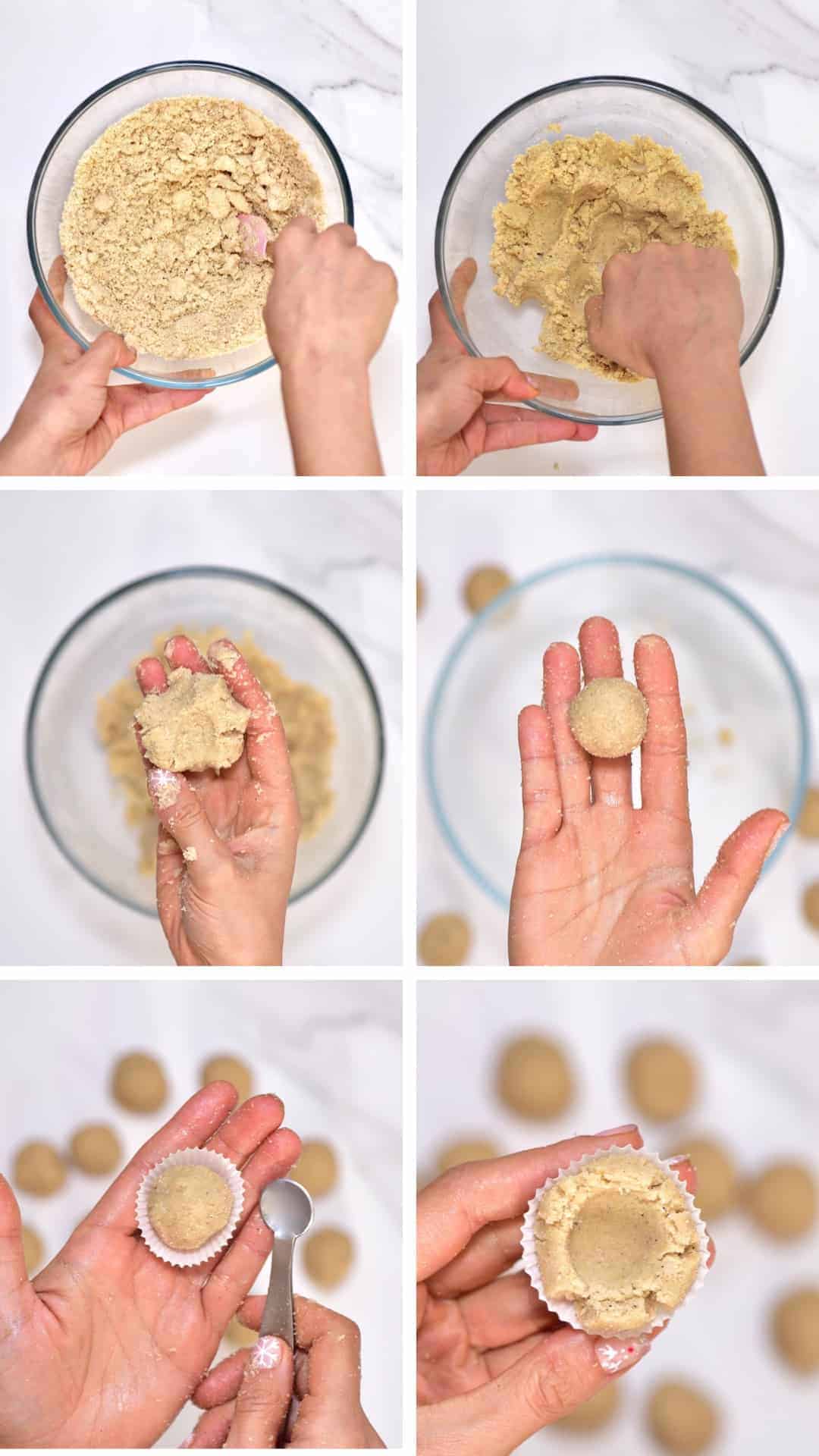
If you’re in a hurry to enjoy these delicious cookies, then you can have these as a no-bake cookie recipe by simply adding some pistachio butter to them now and decorating with some pomegranate seeds and chopped pistachios.
Note* Due to the gluten-free nature of these cookies and the lack of dairy, these cookies are more crumbly than general cookie dough so cracking around the edges when pressing your indentation is perfectly normal.
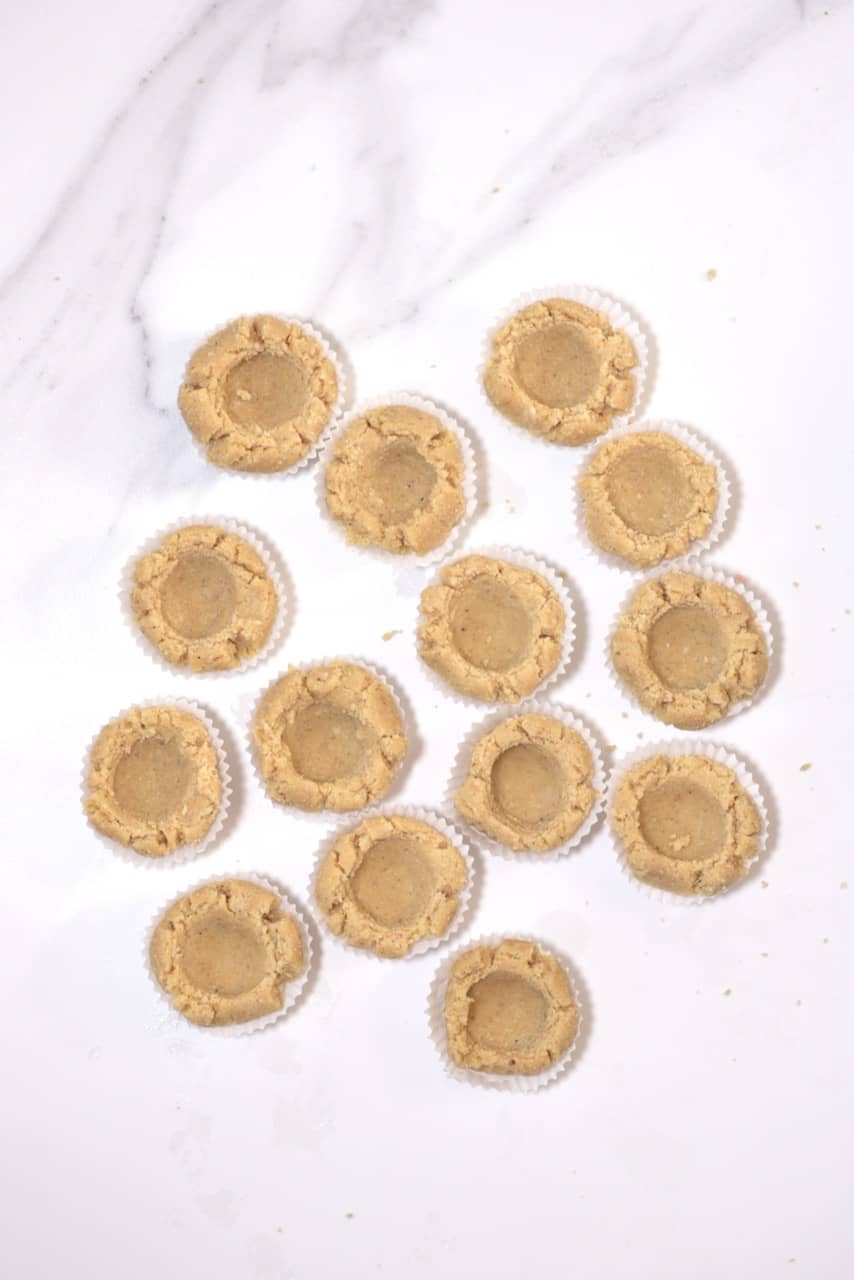
However, if you want to bake the cookies, then you can now bake them in the oven either in mini cupcake cups or on a baking tray lined with parchment paper.
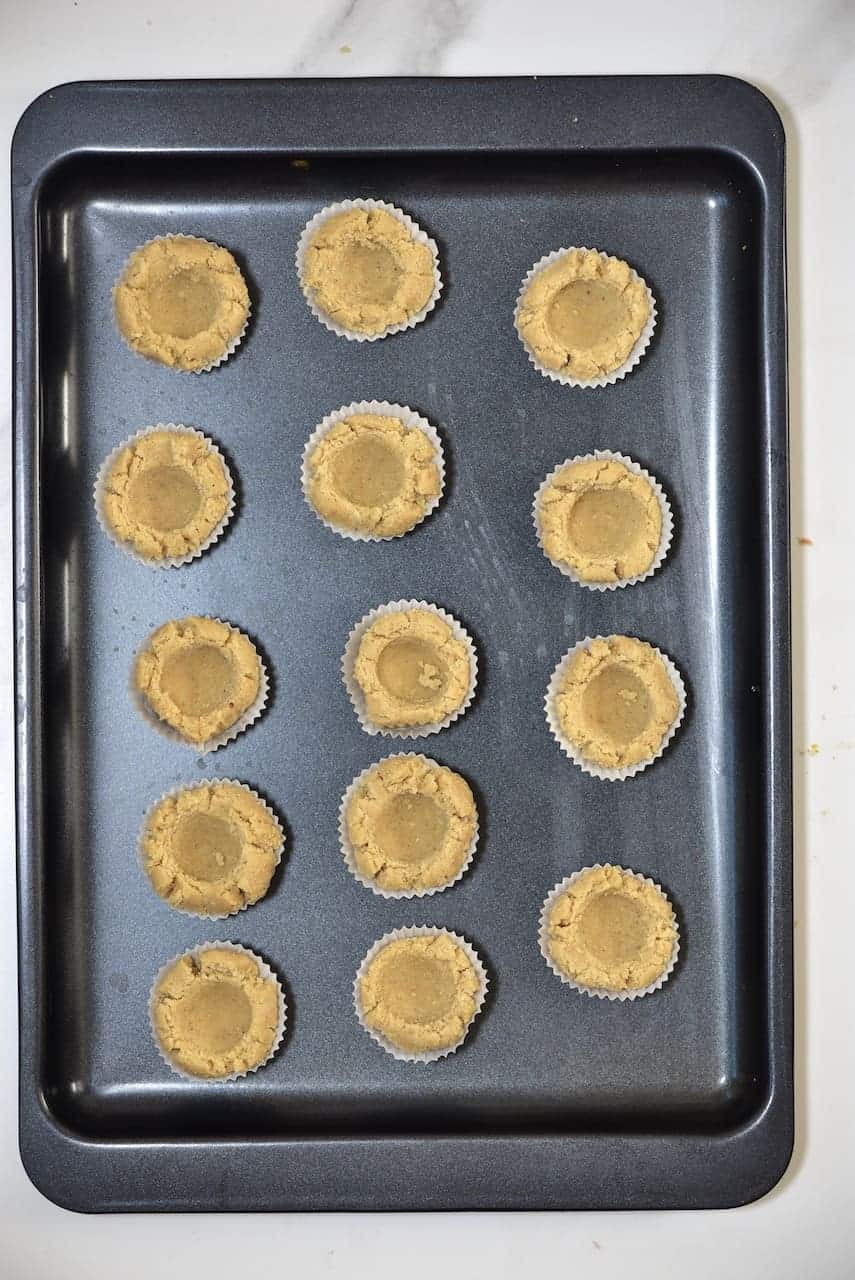
These only take ten minutes to bake in the oven and will turn a lovely golden colour around the edges.
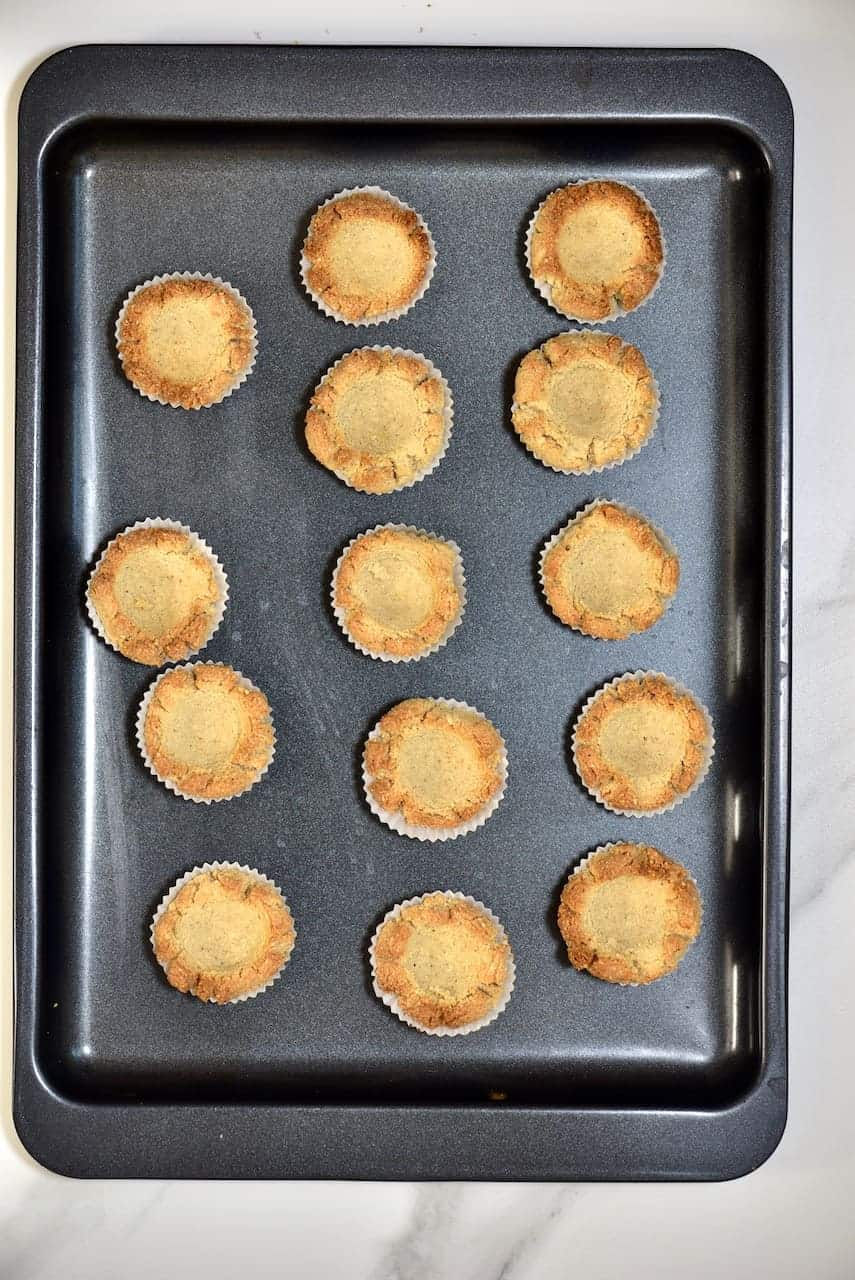
If you want to use some chocolate chips as a filling, you’ll want to add these to the cookies while they’re still warm, so they melt into the thumbprint.
For the pistachio butter-filled cookies, allow the cookies to cool down a bit before filling them.
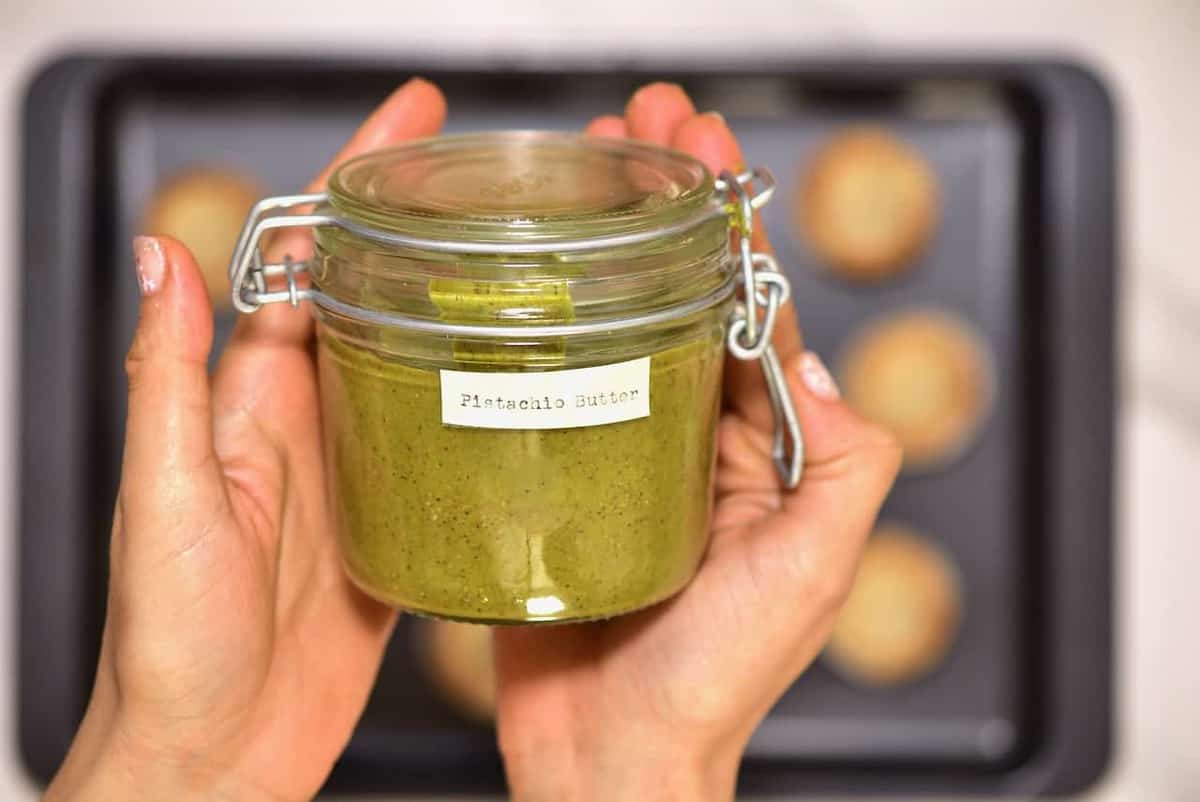
Again you can decorate the pistachio cookies with pomegranate seeds and ground pistachios or even a sprinkle of desiccated coconut. Also, feel free to experiment with other fillings and toppings of your choice.
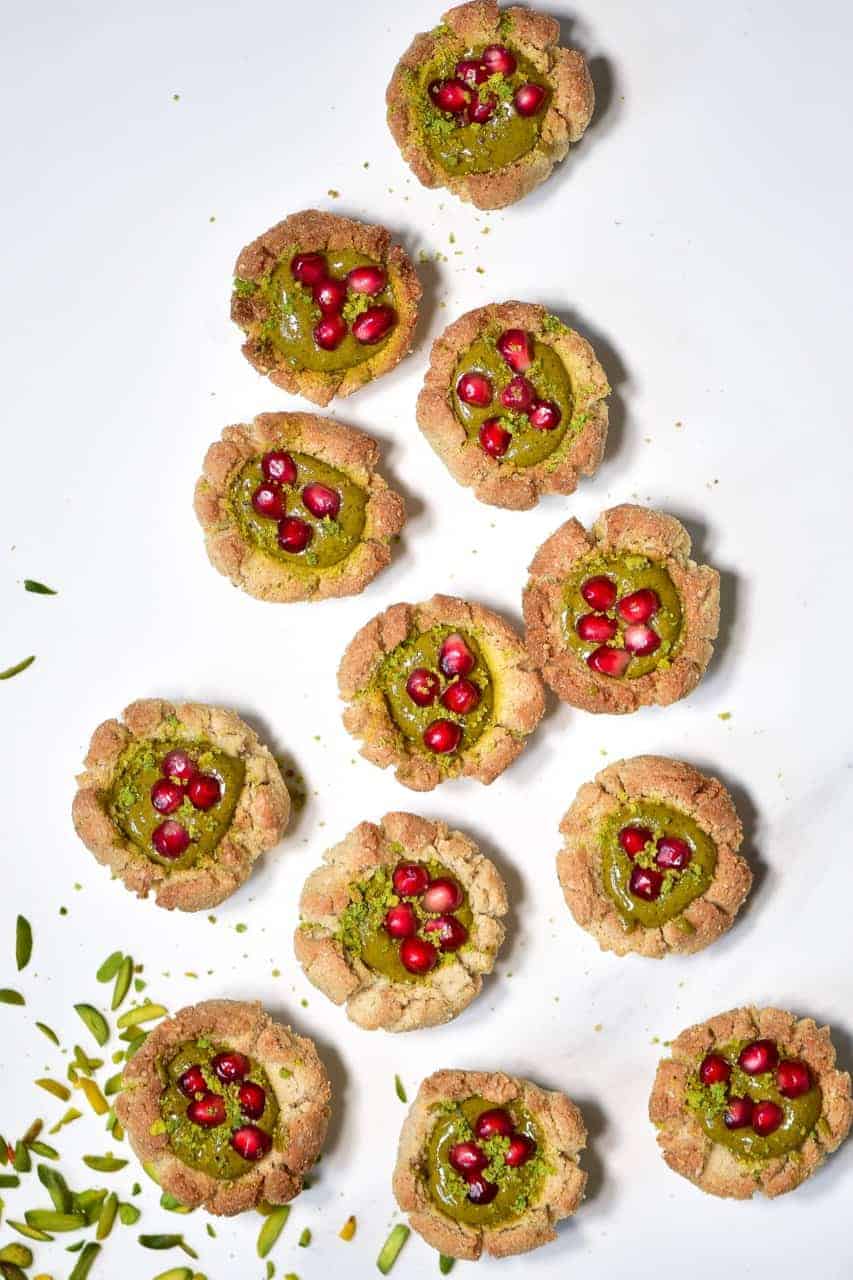
For a sweeter, dessert-like version you can drizzle some white chocolate over the cookies at the end. Or, for a chocolate thumbprint cookie version, you can add some cocoa powder into the base almond cookie recipe.
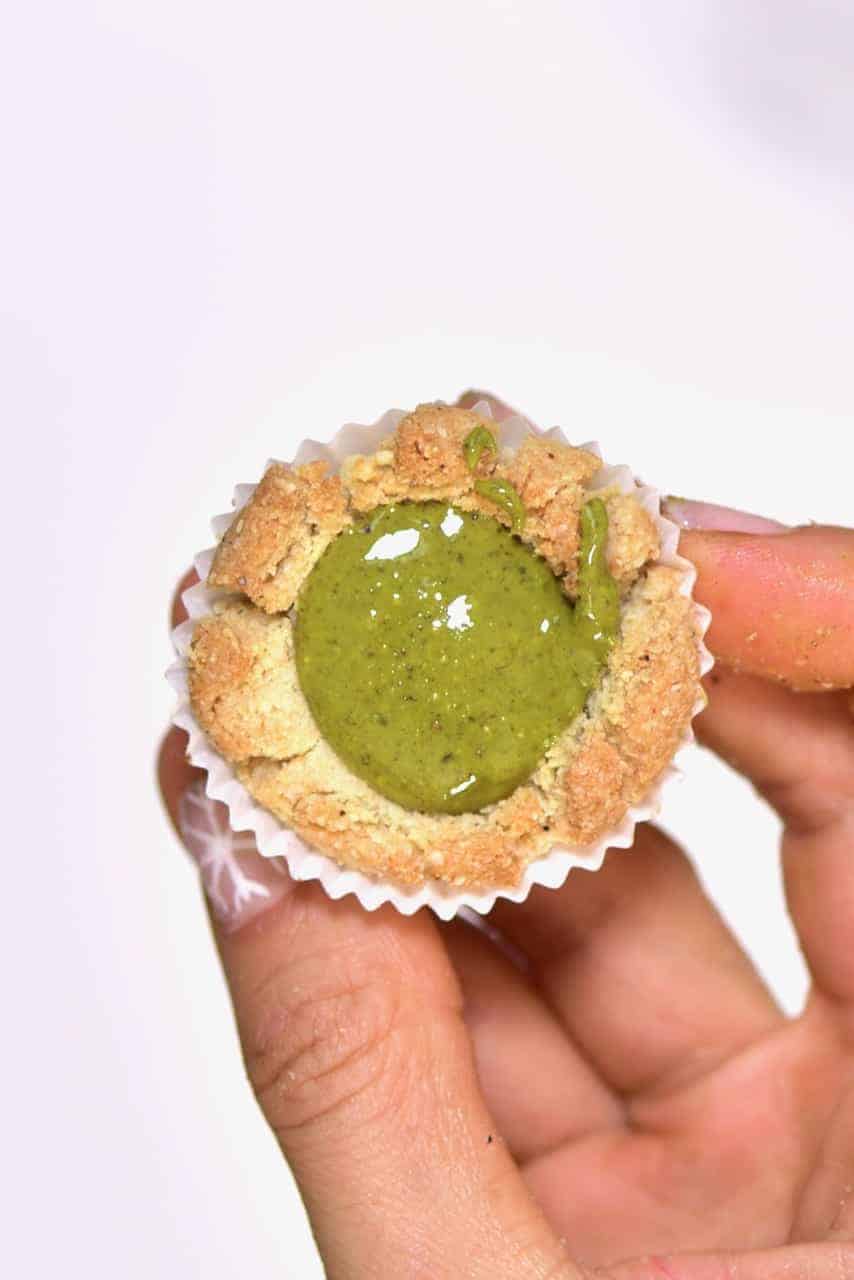
Other great snack recipes you may like
For another delicious no-bake snack recipe, you may like these healthy cacao & almond protein balls or these coconut bliss balls . These 4-Ingredient Stuffed Dates: with home-made almond butter & Chocolate are always a winner too!
IngredientsUS CustomaryMetric1x2x3x
- ▢ 2 cups almond flour
- ▢ 3 tBsp coconut oil
- ▢ 1 tsp ground cardamom powder
- ▢ 2 tBsp maple syrup
- ▢ 2 tBsp coconut flour
- ▢ 1/4 cup pistachio butter
Toppings (optional)
- ▢ ground pistachios
- ▢ pomegranate seeds
Instructions
- To begin, mix the almond flour* with the other base ingredients and then form small, one bite-sized cookies. If you want you can measure these out and use around 1tbsp per cookie. However, I eyeballed it and made 14 of them.
- To make them into thumbprint cookies, the process is precisely what it says. Roll each piece of dough into a ball, and then you can use a finger/ thumb to make the indentations. You could also use the rounded back of a spoon. In fact, I used a small 1/2 tsp measuring spoon for an even indentation in each cookie.**
- If you’re in a hurry to enjoy these delicious cookies, then you can have these as a no-bake cookie recipe by simply adding some pistachio butter to them now and decorating with some pomegranate seeds and chopped pistachios.
- However, if you want to bake the cookies, then you can now bake them in the oven either in mini cupcake cups or on a baking tray lined with parchment paper.
- These only take ten minutes to bake in the oven at 160ºC (fan-assisted) and will turn a lovely golden colour around the edges.
- Once cooled down, add the pistachio butter and decorate.***
Video
Notes
Nutrition
Nutrition information is automatically calculated, so should only be used as an approximation.
Blackberry Jam Recipe (With Video)
Equipment
- 7 Canning jars (8 oz) (250 ml)
- Heavy-based stainless steel saucepan
- Silicone spatula
- Potato masher or another similar tool
Ingredients
- 3.2 pounds blackberries 10 cups whole fresh blackberries (5 cups crushed)
- 3.3 lb white sugar 7 cups
- 1/4 cup lemon juice freshly squeezed or bottled, optional
- 6 Tbsp powdered pectin OR liquid pectin
Instructions
Prepare the jars
- Sterilize your equipment. Wash the jars, lids, and bands in hot, soapy water and rinse them well. If you plan to can the jam, prepare the canner as well (see the steps below).
Using powdered pectin
- Wash and dry the blackberries. Crush them lightly in a bowl (or pan). Add the powdered pectin and mix it well into the crushed berries. Squeeze in the lemon juice and stir to combine.
- Add the blackberry mixture to a medium heavy-based pan and bring to a boil over high heat. Stir frequently to allow the pectin to dissolve completely.
- Add all the sugar and bring the mixture to a full rolling boil, stirring constantly. Once it reaches a full rolling boil, let the jam boil for 1 minute.
- Remove the saucepan from the heat and skim off any excess foam from the surface of the jam. Continue with the jarring steps below.
Using liquid pectin
- Wash and dry the berries and mash them lightly in a bowl (or the pan).
- Transfer them to a medium heavy-based pan and add the sugar and lemon juice. Bring to a rolling boil over high heat and stir constantly.
- Add the liquid pectin and stir to incorporate. Keep the rolling boil for 1 minute and stir constantly.
- Remove the pan from the heat. Skim off any excess foam. Continue with the next step.
Jar the jam
- Place the jars on a heatproof surface and fill them with the jam to about ¼ inches (0.5 cm) from the top.
- Wipe away any spillage on the rim and outside of the jar with a damp cloth, and then seal the jars. This blackberry jam is now ready to enjoy or store short-term in the fridge (3 weeks) or freezer (6 months).
Water-bath canning (optional)
- Prepare your canner by adding the trivet/rack to the bottom and filling it with enough water to submerge the jars by 2 inches. Bring to a boil over medium heat and boil the jars for 10 minutes. Keep them in the water so they stay warm until ready to fill.
- Fill the jars with the jam to about ¼ inch (0.5 cm) from the top, and make sure to remove air bubbles. Adjust the headspace if needed. Wipe the rim. Then screw the lid to fingertip-tight.
- Using tongs, lower your jars back into the pan of boiling water, making sure they are around 2 inches deep. Bring to a boil and process the jars with the lid on for around 10 minutes (this can change depending on your altitude). Then, remove the lid and let the jars rest for 5 minutes in the canner.
- Remove the jars from the water and leave them to cool on a heatproof surface. The lids are sealed properly when they are concave and won’t wiggle when pressed. If you have one that hasn’t been sealed properly, place it in the fridge to use first. The rest can be stored in a cool, dry place like a pantry or a cupboard for up to 1.5 years.
Video
Notes
Nutrition
Recipe on Alphafoodie: https://www.alphafoodie.com/easy-homemade-blackberry-jam-recipe/
